06.11.2026
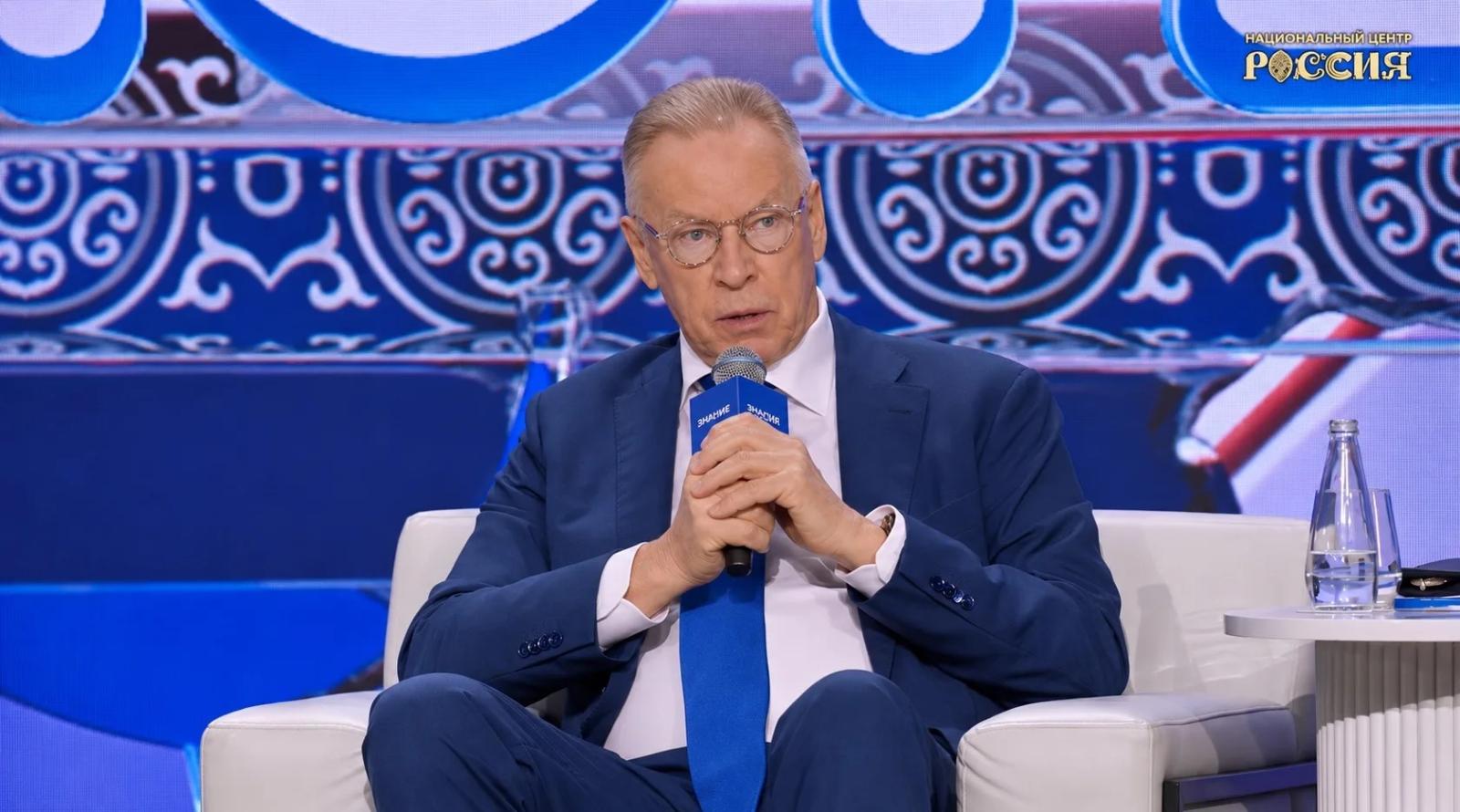
On November 6, RSUH Rector Andrei Loginov took part in a discussion on preserving historical memory at the “Knowledge. Unity” educational marathon at the “Russia” National Center, devoted to the contribution of the peoples of the USSR to Victory in the Great Patriotic War and to countering historical falsifications.
One of the central topics of the discussion was the 13-volume documentary edition The Republics to the Front. 1941–1945, in whose preparation RSUH scholars played a significant role. By bringing together archival materials on the contribution of the Union republics to Victory in the Great Patriotic War, the project made it possible to take a fresh look at the events of the war years, restore little-known pages of the past, and trace large-scale historical processes through the fates of specific people. As RSUH Rector Andrei Loginov stressed, work on the volumes required not only careful study of sources but also overcoming established ideological interpretations.
Behind the dry lines of archival documents there often lie events whose scale is hard to imagine even eight decades later. One such example, Andrei Loginov said, was the mass evacuation of industrial enterprises and the population in the first months of the Great Patriotic War. Andrei Viktorovich compared the mass relocation of production and people with the heroism of Soviet soldiers, recalling the words of Marshal Georgy Zhukov, who called the evacuation a “great labor epic.” At the same time, in Andrei Loginov’s view, the organization of the work of the State Defense Committee, the restoration of industry in the rear and the everyday life of millions of resettled people have not yet received exhaustive treatment in Russian historiography. Behind the large-scale relocation of enterprises and people stood millions of human destinies, each of which in its own way reflected the tragedy of wartime. While some went to the front, others mastered unfamiliar professions, restored production in new territories and kept factories running without interruption amid an acute shortage of resources. No less severe trials fell to evacuated families, who were forced to adapt to unfamiliar living conditions far from their native home.
At the same time, the rapid development of digital technologies sets historical scholarship new tasks connected with establishing the authenticity of sources. Answering the question of how to tell a genuine document from an artificially created forgery, Andrei Loginov pointed to the capabilities of the auxiliary historical disciplines, of which there are now almost fifty. Among them are sphragistics, which studies seals; diplomatics, which examines historical acts; heraldry, numismatics, historical cartography and onomastics.
However, technological capabilities do not eliminate the need to train specialists able to critically evaluate the information obtained and build an evidence-based picture of events on that basis. Andrei Loginov noted society’s growing interest in history, stressing that this demand cannot be met without developing university education and forming a new generation of researchers.
Along with Andrei Loginov, the discussion was attended by Alexei Shevtsov, Deputy Secretary of the Security Council of the Russian Federation, Maxim Dreval, Director General of the Russian Society “Znanie” (Knowledge), and Mikhail Myagkov, Academic Director of the Russian Military Historical Society.


