23.10.2025
At the 17th Assembly of the Russian World, Maxim Krongauz, Chief Researcher of the Laboratory of Sociolinguistics of RSUH, presented a large-scale research initiative.
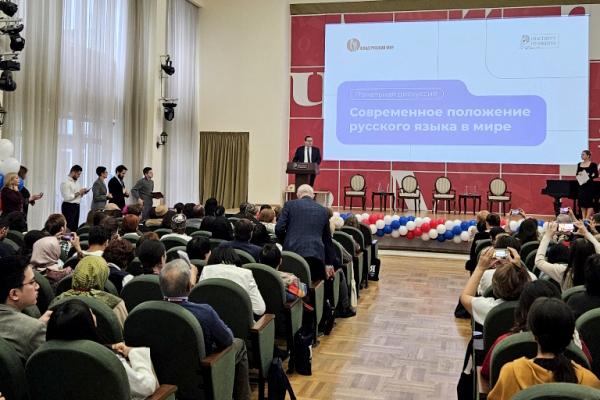
As part of the 17th Assembly of the Russian World, a discussion was held titled “The Position of the Russian Language in the World: Education, Literature, Regional Specifics.”
The discussion was opened by Nikita Gusev, Rector of Pushkin State Russian Language Institute, where leading specialists in Russian language studies from dozens of countries had gathered. He spoke about the main areas of the Institute’s work. The Rector expressed confidence that these areas would also develop within the framework of the Scientific and Methodological Center, the creation of which had been discussed at a meeting of the Presidential Council on the Implementation of State Policy for Supporting the Russian Language and the Languages of the Peoples of the Russian Federation. He reported that just days before, the Government of Russia had submitted a report to the President containing information about the creation of such a unified center based at the Pushkin Institute.
He also recalled that, according to the Index of the Status of the Russian Language in the World study, which Pushkin Institute has conducted since 2020, the Russian language ranks fifth in terms of global prevalence among the world’s twelve leading languages—after English, Spanish, French, and Chinese.
Lyudmila Skakovskaya, Deputy Chairperson of the Federation Council Committee on Science, Education, and Culture, addressed the participants of the 17th Assembly of the Russian World. She noted that new challenges faced Russian language specialists worldwide. Since the enrollment plans for international students in Russian universities are expected to expand significantly, it is important that future applicants already know Russian at a basic level in their own countries. This will allow them to receive a higher-quality education when they come to study in Russia.
For the first time, Institute conferred the title of Honorary Professor of the Russian Language of Pushkin State Russian Language Institute. The first recipient of this high title was Senator Lyudmila Skakovskaya, Professor, and literary scholar, who previously headed Tver State University.
Afterward, participants moved on to the panel discussion “The Current State of the Russian Language in the World.” It was opened by Maxim Krongauz, Professor of RSUH and Pushkin Institute. According to the linguist, the 21st century may become the century of studying substandards in Russian studies. This term, relatively new in the Russian language, encompasses everything beyond the standard—slang, jargon, colloquial speech, and dialects.
“In some countries, teachers are even emerging who teach children to speak dialects. The value of these language components has sharply increased. And we also understand that the richness of the Russian language is based not only on the literary language but also on the popular layer, which is now attracting attention,” the linguist noted.“
In fact, such detailed attention to the Russian language already has a precedent in linguistic history—the Explanatory Dictionary of the Living Great Russian Language by Vladimir Dal, which covered the entirety of the Russian language.
“We have not had such comprehensive dictionaries for a long time, except for some editions dedicated to jargon. There is no other dictionary of this scale in the history of the Russian language. Our task—using new technologies—is to create a vast dictionary encompassing the entire Russian language,” said Professor Krongauz.